

Postal Service Attacks Come Fast in June
The USPS has been at the center of a firestorm of controversy over the past few weeks. News headlines have highlighted attacks on voting-by-mail, high profile senate hearings that threatened Postal privatization, financial worries, and an attempt to appoint corporate extremists to the very top of the Postal Service.
At first glance, these may seem like a series of different fights. But, in reality, they are part of an ongoing struggle between those who see the Postal Service as a public service to be expanded and strengthened in the name of community and democracy, and those who seek only profit and want to restrict and reduce.
USPS Board Nominees Raise Concerns
On June 17, members of the Senate Homeland Security and Government Affairs Committee gathered to consider 13 nominees to a myriad of government agencies. Among them were four candidates for the position of USPS Governor. Two of the quartet were removed from the agenda at the last minute, but it still left the committee with 11 people to question over just two hours.
In response to a question on his support for privatization of the Postal Service, Jeffrey Brodsky said: “I don’t really have a view on whether or not privatizing it would make any sense or not.” He did, however, go on to highlight some of the shortcomings of privatization schemes, especially regarding rural delivery.
Committee Chairman, Rand Paul (R-KY), argued that the workforce at the Postal Service was the problem, arguing that public employees are “not as good because they don’t have the profit incentive.” The second nominee, William Gallo expressed his support for cuts to the Postal Service’s dedicated workforce. “Obviously the workforce, at over 600,000 people, is too high,” he claimed.
Eyebrows were raised as Brodsky warned that “we have to get together and talk about what the universal service obligation is and what it should be.” Soon after, Sen. Josh Hawley (R-MO) pointed out the vital role that the Postal Service plays in rural areas. “It is absolutely vital to me that the Postal Service remain and continue its commitment to servicing all parts of the nation, including rural areas,” said the Missouri senator.
Paul to Steiner: Do Less!
Just six days later, the committee reconvened to question the Postmaster General, David Steiner, on the USPS’s business model. Among the recommendations from committee Chairman Paul were a hiring freeze, reducing delivery to four days a week with a $50 charge to receive mail on days five and six, an end to the universal service requirement to serve every household, and a corporate takeover of local services under the guise of “outsourcing.”
The Kentucky senator, who chairs the Senate’s committee of jurisdiction on the USPS, summed up his approach to the Postal Service as “you should do less business.”
Several senators asked questions about the Postmaster General’s decision to publish a draft rule implementing the March 31 White House Executive order on mail-in ballots.
The draft rule would upend the current USPS system to manage vote-by-mail. It would force states to hand over voter rolls to the Postal Service and to comply with strict standards on envelope labeling. If states do not pass over that personal identifying information, they would be banned from allowing any citizens to vote-by-mail. The information provided would be used and shared for “law enforcement” purposes.
Steiner attempted to deflect when questioned about the draft rule, claiming that it would merely implement a best practice known as “Kit 600”, where mail-in ballots have unique barcodes and envelopes. On further questioning, however, Steiner confirmed that states would not be allowed to vote-by-mail if they did not hand over voter-rolls.
Judges block attacks
The next day, however, a federal judge struck down the executive order. “The Constitution does not grant the President any specific powers over elections,” wrote US District Judge, Indira Talwani in her ruling.
While the executive order was struck down, the USPS draft rule to implement the order is still out for consultation and will remain so until July 2. In a submission to the consultation, American Postal Workers Union president, Jonathan Smith labeled it: “Unprincipled, unworkable and unlawful.”
“No amount of changes can correct its deficiencies and adoption of any part of the rule will crush mailers’ trust in the Postal Service and drive even more people from First Class Mail,” he continued.
The justification for the collection of voter data to share with law enforcement is, he pointed out, “nonsensical.” “In truth, the only law enforcement ends the Postal Service achieves with the proposed rule is creating a surveillance state for Americans who vote through the mail.”
The struggle continues
The June 25 court decision was good news for democracy campaigners and postal advocates. Four days later, more good news came from the Supreme Court, which ruled that states can count legally cast mail-in ballots that were mailed on or before election day but arrived after the date.
The fight is far from over, however. The Senate will vote in the coming weeks on at least two of the four nominees for the Board of Governors. If they are confirmed, those would be two votes at the top of the USPS with little clear commitment to the Postal Service’s public service mission. On the other hand, these skirmishes have brought public scrutiny of the Postal Service with an intensity not seen since 2020, when a broad public campaign forced policy changes and support for our public Postal Service.
We have won before and we can win again.
Maintenance Resolutions Passed at the APWU State Convention
Click here to read the resolutions that the Maintenance Committee at the Illinois APWU State Convention has developed and passed to the National Convention.
Grievance Statement Submission Portal Now Online!
Local 7033 has launched its online grievance statement submission portal. Click here to learn more!
April Financial Disclosure Report
The Local 7033 April financial disclosure report is now available here!
The “Eight Weeks of Safety” campaign
APWU Local 7033 will be having “Eight Weeks of Safety” starting soon! Each week, we will be asking you to submit PS form 1767 for the safety focus of that week. We will provide “cheat sheets” of the particular code violations we’ve identified for each focus area here and on flyers. If we’ve missed any violations that you encounter at work, feel free to add your own!
More information to come at our upcoming meeting:
2:30pm on Sunday, May 17th, 2026
American Legion Post 256
6919 W Roosevelt Rd, Berwyn, IL 60402
How to participate:
Stay tuned to the “News” section of this website to get the “cheat sheet” for the safety focus of the week. You may also ask your steward for a paper copy of the “cheat sheet.”
Get a PS Form 1767. You may ask for this form from your supervisor. Supervisors are required to have these forms available to you. If your supervisor does not make these forms available, ask your steward for a form.
Use the “cheat sheet” to write a PS Form 1767 about one or more safety hazards from the ones listed. If we missed a safety concern that you face on the job, feel free to add your own!
3a) If your supervisor or manager is harassing or abusing you, write a PS Form 1767 about the harassment or abuse you’ve suffered. Harassment and abuse is unacceptable conduct and is contrary to workplace safety and well-being, which the PS Form 1767 is meant to address. Talk to a steward or union officer if your supervisor or manager is yelling at you or you are experiencing negative health effects from mistreatment. For further information about dealing with workplace harassment, look here.
Ask your steward if craft and tour has a point person for the campaign. If you have a point person available, give your PS Form 1767 to them. If you do NOT have a point person available, please go to this page to submit documentation of your form to the union when you give your PS Form 1767 to your supervisor.
Your supervisor is required to give you a signed copy of your PS Form 1767 within 24 hours of submission. It is your supervisor’s responsibility to monitor the status of the report at all times until the hazard is abated. If the hazard persists longer than 7 days, your supervisor must verbally inform you as to abatement status at the end of each 7-day interval. If your supervisor fails to follow any of these steps, your steward must file a grievance.
For further information on the PS Form 1767 process, click here.
Local 7033 survey
It all begins with an idea.
Here are our initial findings from the APWU Local 7033 Member Survey which closed at 11:59pm on Friday, March 15th, 2026.
Key takeaways:
58% want the union to focus on grievances
32% want the union to communicate more effectively
22% do not know who their stewards are
28% of respondents fear retaliation from management.
Job security (13%), Safety (24%) and Staffing (13%) are the largest concerns.
Lowest condition rating across crafts was overtime seconded by training and equipment.
Lowest overall condition rating for clerks was overtime seconded by contract compliance.
Lowest overall condition rating for maintenance was training and equipment seconded by safety.
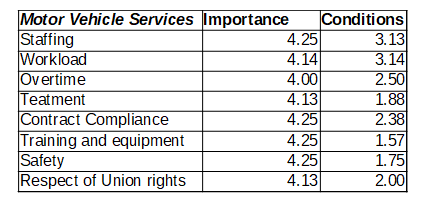
Lowest overall condition rating for motor vehicle services was training and equipment seconded by safety.
Data tables
The table below gives a breakdown of survey responses by tour and craft.
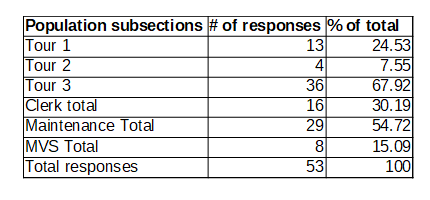
The survey asked respondents about the following issue areas:
Staffing
Workload
Overtime practices
Treatment by management
Contract compliance by management
Having the training and equipment to do your job
Workplace safety
Management respect for union rights
Respondents were asked to rate the importance of each issue area to them on a scale of 1 to 5 (1=not important to 5=very important). They were also asked to rate current conditions at RPDC with regard to these issues on a scale of 1 to 5 (1=poor to 5=excellent). The table below shows the overall scores of all respondents.
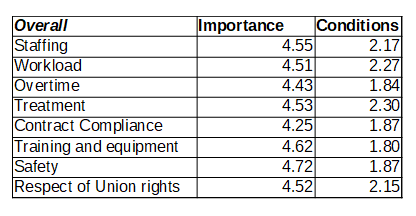
The table below shows the scores of Clerks only.
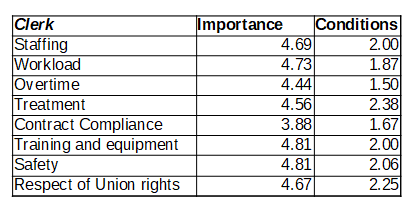
The table below shows the scores of Maintenance only.
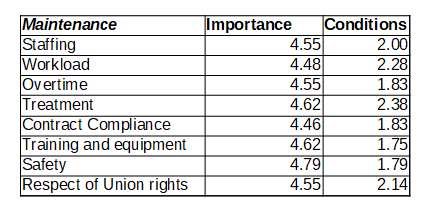
The table below shows the scores of Motor Vehicle Services only.
February financial disclosure
It all begins with an idea.
A copy of our local’s financial disclosure is available here.